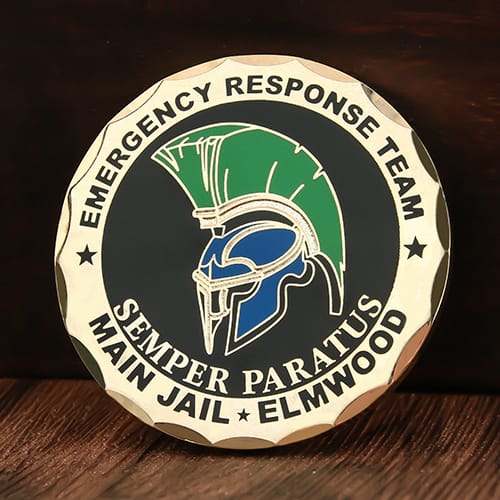
Common challenge coin sizes
Coin sizes are quoted by diameter: in inches in the US, in millimeters almost everywhere else. For shaped coins such as shields, badges and dog tags, the size is the longest dimension, so a 2″ shield measures 2″ from top to point. Most coins fall between 1.5″ and 2″, and 1.75″ is the most common.
| Size | Metric | Common use | Design room |
|---|---|---|---|
| 1.5″ | 38 mm | Event coins, large handouts, simple logos, tighter budgets | One emblem and a short ring of text; keep detail bold |
| 1.75″ | 44 mm | Unit, department and company coins; the everyday standard | A crest plus a motto or name around the rim |
| 2″ | 51 mm | Detailed crests, commander's coins, presentation coins | Crest, rim text and secondary details on both sides |
| 2.5″ | 64 mm | Retirement, anniversary and senior leader coins | Scenes, maps, long dedications and 3D relief |
| 3″ | 76 mm | Commemorative and display pieces; too big for most pockets | Large artwork, several elements, deep sculpting |
When to use each size
1.5 inches. About the size of a classic US silver dollar. It's the economical choice when you're handing out hundreds of coins at an event or giving one to every member, and it works well for a single logo with a name. Fine crests and long mottos get cramped.
1.75 inches. The size most people picture. It sits comfortably in a pocket, it's easy to carry for a coin check, and it gives a unit crest or department badge enough room for clean lettering around the edge. If you're unsure, start here.
2 inches. A clear step up in presence and weight. A 2″ coin has about 30% more face area than a 1.75″ coin, often the difference between a crest that's legible and one that's crisp. It's a natural size for commander's coins and designs with real detail on both sides.
2.5 and 3 inches. Presentation sizes. These coins are displayed more often than carried: on a desk stand, in a case or in a shadow box. They suit retirements, anniversaries, memorials and senior leadership coins, and they give 3D sculpting and cut-outs room to work.
See the sizes at actual scale
Screens vary, so the chart below asks you to calibrate it against a bank or credit card first. Once it's set, the circles show each size from 0.75″ to 3″ at true scale. Hold a coin you already own against the screen to compare, or print the chart at 100% and lay coins on it.
Actual-size pin chart
Calibrate once with any bank or credit card, then the circles below show true size on your screen.
Step 1: hold a card against the screen and drag until the outline matches its width.
No card handy? The default assumes a standard 96-pixels-per-inch screen, which is close on most laptops.
Step 2: compare sizes.
Tiny: one simple icon or initials
Small logo pins, tie tacks
Classic lapel pin
Most popular enamel pin size
Bold art pins; standard coin size
Statement and trading pins
Large trading pins, race medals
Oversized pins, medals, buckles
The dashed ring shows a typical safe area: keep small text inside it so it isn't lost in the border.
No chart handy? A US quarter is just under 1″ (24.26 mm) across and 1.75 mm thick. A 1.75″ challenge coin is nearly twice as wide, and at 3.5 mm, twice as thick.
Challenge coin thickness
Most challenge coins are about 3–4 mm thick. Thickness is what gives a coin its heft: two coins of the same diameter feel completely different in the hand at 2.5 mm and at 4 mm. A thin coin can feel like a token, while one at the upper end of the range feels like something to keep.
Go thicker when the design has 3D sculpted relief, which needs depth to carve into, or when you want a weighty presentation coin. Edge work benefits too: rope and diagonal-cut edges and laser-engraved edge text read better on a thicker rim. Thicker coins use more metal, so they cost more, and they may need deeper capsules and wider rack grooves when it's time to display them.
Shapes: round, shield, dog tag and custom die cut
- Round. The traditional coin, and the simplest shape to make, carry and display.
- Shield. A natural fit for police and sheriff's offices, security teams and any design built around a crest.
- Dog tag. The familiar rounded-rectangle tag outline, popular for military, veteran and memorial coins, sometimes with a hole for a chain.
- Custom die cut. The outline follows your artwork: a state map, a badge star, an arrowhead, an aircraft, a fire helmet. See-through cut-outs inside the coin are possible too.
Shaped coins need a mold cut to the outline and are often die cast in zinc alloy, which handles complex shapes and cut-outs well. Our guide to how challenge coins are made explains die striking and die casting step by step.
How size affects detail and text
A coin's design lives inside its rim, and the face area grows with the square of the diameter. A 2.5″ coin has about twice the face of a 1.75″ coin, and a 3″ coin about four times the face of a 1.5″ coin. That extra room is what lets bigger coins carry scenes and long text.
- Text. Keep lettering at least 1 mm tall at the final size. Mottos and names usually run in a ring around the rim; a long dedication may need the back, the edge or a bigger coin.
- Fine lines. Thin lines and tiny enamel areas fill in on small coins. Bolder line work, or an antique finish that lets the relief carry the detail, helps at 1.5″.
- Enamel colors. Each color needs its own area, separated by metal. Smaller coins have room for fewer distinct colors before details start to merge.
- Two sides. Every coin has a back. On a smaller coin, move secondary elements there instead of shrinking everything to fit one face.
You'll see every element at its real size on your free digital proof, and we flag anything too fine to make cleanly before production starts.
What affects the cost of a challenge coin
We don't publish a coin price list, because every coin is a different mix of size, metal, finish and quantity, and a number that fits one order would mislead the next. Quantity usually matters most. These are the factors that move the price:
| Factor | Why it matters |
|---|---|
| Quantity | The mold is a fixed cost shared across the run, so the price per coin falls as the order grows |
| Size | A bigger coin needs a bigger mold and more metal |
| Thickness | More metal in every coin, and more weight to ship |
| 3D sculpting | Sculpted relief takes extra artwork and a more complex mold |
| Plating | Antique finishes and dual plating add steps beyond a single polished plating |
| Color count | Each enamel color is filled separately |
| Edge work | Rope, diagonal-cut and wave edges, and laser-engraved edge text, add operations |
| Shape and cut-outs | Custom outlines and see-through areas need a more complex mold |
| Personalization | Serial numbers or individual names are engraved coin by coin |
| Packaging | Acrylic capsules and velvet boxes cost more than a simple PVC sleeve |
Our quotes are all-in: shipping to most destinations is included, there are no setup or rush fees, and the minimum quantity is confirmed on your quote. If budget is tight, ask for two sizes on the same quote, say 1.75″ and 2″, and compare real numbers. The custom challenge coins page covers finishes, edges and packaging.
Choosing a size: quick checklist
- Will people carry it every day? Stay at 1.75″ or 2″.
- Handing out hundreds at an event, or one to every member? Consider 1.5″ with a bold, simple design.
- A detailed crest, or a lot to say on both sides? Go to 2″.
- A retirement, memorial or coin for the shelf? Look at 2.5″ or 3″, with 3D relief if the design suits it.
- A shaped coin? Size it by the longest dimension and check that the narrow parts still fit your text.
- Still unsure? Print the size chart, cut out two circles and hold them in your hand.
Get your coin sized and quoted
Send your artwork and tell us how the coins will be used. We'll suggest a size on your free proof and send an all-in quote within one business day.
Start a coin quote