What is a nurse pinning ceremony?
A pinning ceremony is a nursing program's own rite of passage. Each graduate is called forward and receives the school's pin, which many wear throughout their career as a sign of where they trained. It's separate from commencement: graduation is the college's event for every student, while pinning belongs to the nursing faculty, the graduating class and their families.
Ceremonies are held for registered nursing programs (ADN and BSN), practical nursing programs (LPN and LVN) and, at some schools, accelerated and graduate programs. Not every school holds one, and each program runs its ceremony its own way.
History of the nursing pin
The custom is most often traced to Florence Nightingale, who founded her nurse training school at St Thomas' Hospital in London in 1860. Queen Victoria awarded her the Royal Red Cross in 1883, and the widely told version is that Nightingale in turn honored her best graduates with a badge or medal of excellence. Accounts differ on the details, so treat the specifics as tradition rather than settled history.
Some histories reach back much further, to the Knights Hospitaller, a medieval order that cared for sick and wounded pilgrims and crusaders and wore the cross later known as the Maltese cross. That link is symbolic more than documented, but the Maltese cross still appears on many nursing pins.
In the United States, nursing schools began giving pins to graduates in the late 1800s; Bellevue Hospital's training school in New York is often cited as presenting one of the first, around 1880. By the early 20th century, giving every graduate a school pin was an established custom in both the US and Britain.
When does the pinning ceremony happen?
Pinning comes at the end of the program, after final coursework and clinicals and usually before graduates sit the NCLEX licensing exam. Many schools hold it in the days or weeks around commencement, sometimes the day before. Because most programs finish in spring or winter, ceremonies cluster in May and December, with smaller peaks for summer cohorts.
Who pins whom?
Traditionally, faculty pinned each graduate. Today many programs let graduates choose who places the pin: a parent, partner, child, mentor or a nurse in the family. A faculty member hands the pin to that person, who fastens it to the graduate's uniform or gown, usually on the left side over the heart. At many schools a short dedication written by the graduate is read aloud while they're pinned.
The typical order of a pinning ceremony
Programs vary, but a common running order looks like this:
- Processional. Graduates enter, often in white uniforms or their program's scrubs.
- Welcome from the dean or program director, and at some schools an invocation.
- Guest speaker, often a nurse leader, an alum or a faculty member chosen by the class.
- Awards for academic, clinical or leadership achievement.
- Pinning. Each graduate's name is called, their dedication is read and the pin is placed.
- Lamp or candle lighting, honoring Nightingale, “the lady with the lamp,” and the care graduates carry into practice.
- Pledge. The class recites a pledge together, often the Nightingale Pledge.
- Closing remarks and recessional, usually followed by a reception for families.
Planning tips for organizers
- Collect each graduate's pinner and dedication early, with a word limit, so the readings stay brisk.
- Pack the pins in the order names will be called, each labeled with the graduate's name.
- Check the venue's rules on open flames; many ceremonies use battery-powered candles or lamps.
- Keep a few spare pins at the front in case one is dropped or a back goes missing on the day.
What's said: the Nightingale Pledge
The pledge most associated with pinning is the Nightingale Pledge, written in 1893 by Lystra Gretter and a committee at the Farrand Training School for Nurses in Detroit and named in Nightingale's honor. Modeled on the physicians' Hippocratic Oath, it's a short promise to practice faithfully, do no harm, keep patients' confidences and devote oneself to their welfare.
The wording has been revised over the years, and many schools now use an updated version, the International Council of Nurses pledge, or an oath written by the faculty or the class. If you're planning the program, confirm which text your school uses and print it in the program so families can follow along.
What a nursing school pin looks like
School pins are made to last a career, so most follow a traditional formula:
- The school's seal or crest, the school name and often the graduation year.
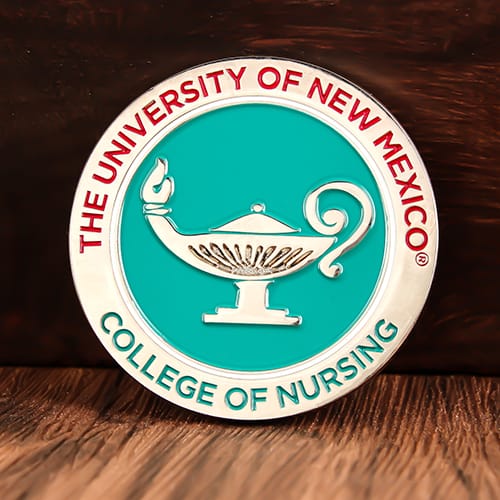
- A lamp, the most common nursing symbol, for Nightingale's night rounds.
- A cross, often the Maltese cross, or a caduceus or rod of Asclepius for medicine.
- The credential or program, such as RN, BSN or LPN.
- A motto, often in Latin, around the border.
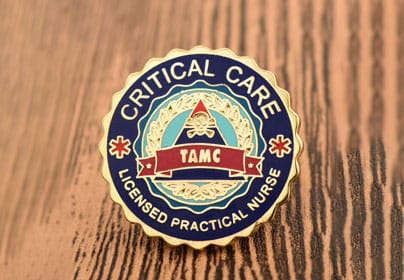
The classic construction is hard enamel with gold plating: the polished, jewelry-like face suits a pin worn on a uniform for decades and stands up to daily wear. Soft enamel, like the pin pictured above, is a lower-cost alternative. Nursing pins are small, about an inch across or less, with a safety-pin style backing or a clutch post, and many schools present them in a small box.
How schools commission nursing pins
Who orders varies. Some nursing programs buy a pin for every graduate; at others a pin committee of faculty and class officers chooses the design and students buy their own. Many schools keep one design for decades so every class wears the same pin, changing only the year.
- Confirm the design rights. Get the school seal or logo, and sign-off to use it, from the college's marketing or communications office.
- Send the artwork or a sketch. Our artists redraw it as vector at no charge, and the first proof usually arrives in 1–2 business days.
- Revise until it's right. Proofs and revisions are free and unlimited, so the dean or committee can review every round.
- Set the quantity. Count graduates plus a few spares for late completers, faculty and replacements. Our minimum is 25 pins, which suits small cohorts.
- Choose backing and packaging. Safety-pin or clutch backing, plus boxes if pins are presented at the ceremony.
- Approve and produce. Production and delivery take 30–40 days from artwork approval.
We store dies for two years, so a reorder of the same design skips setup and matches the previous class exactly. See healthcare and nursing pins for hospital and Nurses Week ideas.
When to order nursing pins
Count back from the ceremony date and leave margin. Production takes 30–40 days from artwork approval and there's no rush service, while school sign-offs often take longer than planned. Approving artwork about 2–3 months before the ceremony leaves room for a late approval or a shipping delay.
| Ceremony | Start the design | Approve artwork by | Pins delivered (30–40 days) |
|---|---|---|---|
| Mid-May | January | Mid-February to mid-March | Mid-March to late April |
| Mid-August | April | Mid-May to mid-June | Mid-June to late July |
| Mid-December | August | Mid-September to mid-October | Mid-October to late November |
Enter your ceremony date below to get an exact approve-by date.
Order-by date calculator
Enter the date you need your pins, coins or medals in hand. We work backwards from our real production and shipping times.
Request a quote by
—
Approve artwork by
—
In hand
—
Plan your school's nursing pin
Send your seal, a sketch or last year's pin. You'll get a free proof in 1–2 business days and an all-in quote, shipping included, within one business day.
Start a nursing pin quote