How hard and soft enamel pins are made
Both styles start the same way. Your artwork is turned into a steel die, and the die stamps a metal blank so every outline becomes a raised metal line with recessed wells between the lines. The wells are where the color goes. The difference between hard and soft enamel is what happens after the color goes in.
Soft enamel
Colored enamel is filled into each well and cured, and the pin is not ground down afterward. The enamel settles a little below the metal lines, about 0.3 mm, so the metal stands proud and frames every color. One fill and no polishing is why soft enamel is the cheaper, slightly quicker process.
Hard enamel
The wells are overfilled, usually one color at a time, and cured between fills. Then the whole face is ground and polished until the enamel and the metal lines form one flat, level surface. That polishing stage adds a day or two in the factory and is the main reason hard enamel costs more.
Hard vs soft enamel comparison table
| Hard enamel | Soft enamel | |
|---|---|---|
| Surface | Flat and polished; enamel level with the metal | Textured; enamel sits below raised metal lines |
| Feel | Smooth and glassy, like jewelry | Ridged: you feel every metal line with a fingertip |
| Look | Even shine across the whole face; quiet and refined | Bold outlines with small shadows; more depth and punch |
| Detail | Crisp; fine lines and small text stay clean | Very good; raised lines make outlines and lettering pop |
| Durability | Excellent; nothing raised to catch, scratch or chip | Good; raised edges take the wear, and an epoxy dome adds protection |
| Cost | Typically 10–15% more | The more affordable enamel style |
| Production time | A day or two longer in the factory | Slightly quicker (no polishing) |
| Delivery from Pork Pins | 30–40 days from artwork approval | 30–40 days from artwork approval |
| Best for | Awards, service pins, corporate logos, uniforms, alumni and membership pins | Merch, art and fandom pins, events, schools, trading pins, giveaways |
| Plating options | Gold, silver, copper, black nickel, antique finishes, rose gold (dyed black and rainbow don't survive polishing) | All of those, plus dyed black and rainbow |
| Epoxy dome | Not needed; the face is already smooth | Optional clear dome for a smooth, glossy face |
Which pin style is right for you?
Answer five quick questions and we'll suggest a style. Not sure? Leave it to us on the quote form.
Answer the questions to see a recommendation.
Surface, feel and look
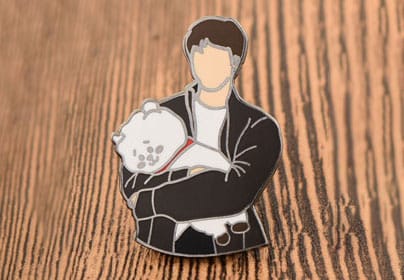
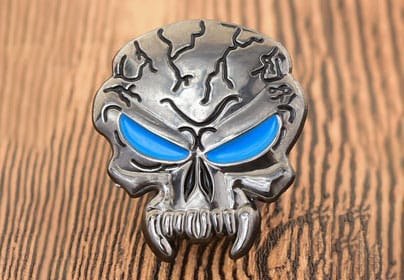
The quickest test is your fingernail. Run it across a hard enamel pin and it glides over one continuous surface; on a soft enamel pin it bumps over every metal line. You can see the difference too: hard enamel reflects light evenly across its face, while soft enamel catches light on the raised metal and leaves small shadows in the wells.
That texture isn't a flaw. Soft enamel's raised lines make outlines look bolder and give illustrated designs a dimensional punch, which is why so many artist, fandom and convention pins are soft enamel. Hard enamel reads as quieter and more finished, closer to a piece of jewelry or a traditional badge.
Durability
Hard enamel is the tougher finish for everyday wear. With nothing standing above the surface, there's no edge to snag on a bag strap or scrape against keys, and the polished face wipes clean. Pins worn daily on a lapel, lanyard or uniform for years are the classic case for hard enamel.
Soft enamel holds up well too, but the raised metal lines take the knocks. Over years of hard use the plating on those high points can scuff, and the recessed wells collect dust. For pins that live on backpacks or are sold to customers, a clear epoxy dome closes most of that gap. Both styles resist fading in normal use; harsh solvents and ultrasonic cleaners are what damage enamel.
Cost: how much more is hard enamel?
Hard enamel typically costs 10–15% more than the same design in soft enamel. On a 100-piece order where soft enamel lands around $3.50 a pin, that's roughly 35 to 55 cents more per pin, or $35–55 across the whole run.
Style is rarely the biggest lever, though. Quantity matters far more: going from 25 to 100 pieces often roughly halves the per-pin price, because the cost of the die is shared by more pins. Size, color count and extras like premium backings also move the number. See pricing for the quantity bands, or try the pin price calculator.
Best uses for each style
Choose hard enamel for
- Corporate logo pins, employee recognition and years-of-service pins
- Police, fire and military pins worn on uniforms
- Nursing school, graduation, alumni and membership pins
- Awards and gifts where the pin should feel premium
- Designs with fine lettering or thin lines that need to stay crisp
Choose soft enamel for
- Artist, fandom and convention pins, where the texture is part of the appeal
- Event giveaways and large runs where the per-pin price matters most
- School, club and team pins, including trading pins
- Bold, colorful designs with thick outlines
- Pins you plan to finish with an epoxy dome for a smooth face at a lower price
Epoxy dome: the soft enamel middle ground
An epoxy dome is a thin layer of clear resin poured over a finished soft enamel pin and cured. It fills the wells, smooths the surface, adds gloss and protects the enamel and plating from scratches and dirt. Up close it looks and feels slightly rounded, like a lens, rather than dead flat like hard enamel.
The trade-offs: the dome hides the ridged texture, it can pick up fine scuffs over time, and it adds a small per-pin cost. It suits soft enamel pins that will be worn on bags or sold, and suits collectible pins less, since collectors often buy them for the texture. Hard enamel doesn't need a dome. Printed pins always have one, because the dome protects the print.
Cloisonné vs hard enamel: an honest note
True cloisonné is made with powdered glass enamel, fired in a kiln at roughly 1,500°F (around 800°C) and then stone-polished. The result really is glass: very hard, very glossy and long-lasting. It also costs considerably more, and glass enamel offers a narrower range of colors that can't always be matched exactly to a brand color.
Most pins sold as hard enamel today, and many sold as “cloisonné,” use imitation hard enamel: an epoxy-based enamel cured at a far lower temperature and then polished flat. Finished pins look almost identical, imitation hard enamel can be matched to Pantone colors, and it costs much less. If a listing promises cloisonné at hard enamel prices, it's very likely the imitation kind, so ask the maker. Our hard enamel pins are imitation hard enamel. If your specification really calls for fired glass cloisonné, say so in your quote request and we'll confirm what's possible.
When die struck or printed beats both
Enamel isn't always the right answer. Three other styles win in specific cases:
- Die struck skips color entirely. The design is stamped into the metal and the recessed areas can be sandblasted or antiqued for contrast. It suits seals, crests, rank and text-only designs, looks formal and traditional, and is among the most affordable styles because there's no enamel step.
- Printed pins carry full-color artwork under a clear epoxy dome, so gradients, photos, tiny text and unlimited colors all reproduce. Enamel needs a metal line between every color, so a design with shading or a photo can't be made in hard or soft enamel at all. Printed pins also arrive a little sooner, about 25–35 days from approval.
- 3D sculpted pins use several levels of metal relief instead of flat color, for mascots, faces and emblems that should feel carved rather than drawn.
Decision checklist
Work down the list and stop at the first yes:
- Does the design have gradients, photos or soft shading? Choose printed.
- Is it a seal, crest or text-only design that doesn't need color? Consider die struck.
- Will it be worn every day on a uniform, lanyard or lapel, or given as an award? Choose hard enamel.
- Is it merch, a collectible or a trading pin where texture is part of the appeal? Choose soft enamel.
- Is the per-pin price the tightest constraint, say 500 event giveaways? Choose soft enamel.
- Want soft enamel pricing with a smooth, protected face? Choose soft enamel with an epoxy dome.
- Still torn? Ask for both styles on one quote and decide with real numbers.
Whichever you pick, you'll see a free digital proof, usually within 1–2 business days, before anything is made, and revisions are unlimited.
Get hard and soft enamel quoted side by side
Send your artwork or a sketch and ask us to price both styles. You'll get an all-in price, shipping included, within one business day. Lapel pins start at 25 pieces.
Get a free quote