How pin trading works
At youth baseball and softball tournaments, each team brings a pin designed for that season, and players swap them with kids from other teams between games, at the hotel and at organized trading sessions. By the end of the event, a player has a towel or bag covered in pins from teams they played or simply met. Hockey has a similar culture at large youth tournaments, and some soccer and other travel teams trade too.
A trading pin is a team’s calling card. Kids notice which pins are big, bright or clever and go after those first, and families keep the collection as a record of the season. That is why teams put more thought into a trading pin than into an ordinary lapel pin.
What makes a good trading pin
Designing your own trading pins? These are the elements collectors look for:
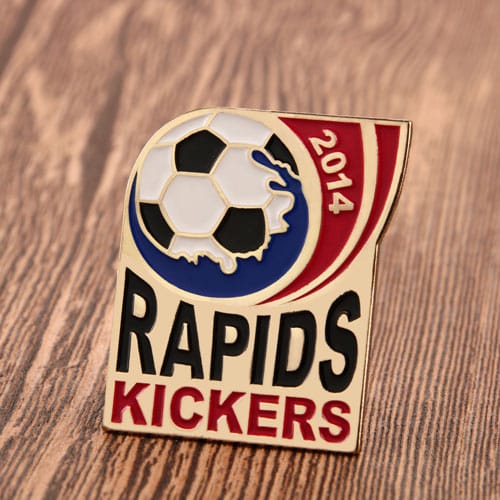
- Team name and year. The year turns a pin into a record of one season, and it is the first thing traders check.
- A mascot or strong central image. A character, an animal or the team logo, drawn large enough to read across a table.
- Tournament or hometown. A city, state or tournament name tells other kids where you came from. If an event has its own logo, get the organizer's permission before using it.
- Bold, contrasting colors. Bright enamel inside dark or gold metal lines stands out on a crowded pin towel. Avoid lots of similar shades.
- A size that stands out. Trading pins usually run 1.5″ to 2.5″, well above a typical 1″ lapel pin. Bigger gets noticed but costs more per pin; 1.75″ to 2″ is a common balance.
- An interesting shape. Cut the pin to the outline of a mascot, a jersey, a home plate or a state rather than a plain circle.
Sport-specific ideas are on the baseball, softball and hockey pages.
Why soft enamel is the usual choice
Most trading pins are soft enamel: bright colors, raised metal lines you can feel, and the most affordable enamel style for a big run. An epoxy dome is optional; it adds a glossy protective coat but smooths over the raised texture. Hard enamel costs about 10–15% more for a polished, flat face, and printed pins handle photos and gradients. Black nickel or dyed black metal makes colors pop; gold and silver are the classic look.
Add-ons buyers ask about
Trading pin buyers often ask for moving parts and special effects: spinners (a piece that rotates), danglers (small charms hanging below the main pin), sliders (a piece that moves along a track), blinkers (small battery-powered lights) and glitter enamel. They aren't on our standard options list, so we won't promise them up front. Ask, and we'll confirm what's possible on your proof, along with any change to price or timing.
Standard options that help a trading pin stand out: custom shapes and cut-outs, a choice of platings including black nickel and rainbow, 3D sculpted mascots, a sponsor or team name stamped on the back, and printed backing cards.
How many trading pins to order
The usual starting point is one pin per player for each team they will meet, plus extras for coaches, umpires, siblings and second trades. A 12-player team at a 20-team weekend trades with 19 other teams: 12 × 19 = 228 pins, so about 250 with spares. Week-long destination tournaments can bring together around a hundred teams, and trading there goes well beyond other players.
How many trading pins do we need?
A planning estimate for one tournament. Adjust the numbers to match your roster and event.
Suggested order
—
Round up rather than down: running out mid-tournament is the most common regret, and leftovers make good keepsakes.
Round up. A reorder still means weeks of production, so running out mid-season is hard to fix, while leftover pins become gifts for sponsors, coaches and grandparents.
When to order
Start 2–3 months before the tournament. Proofing can take a few days or a few weeks, depending on how quickly your team agrees on a design, and production and shipping take 30–40 days after you approve the artwork. There's no rush service, so a pin ordered three weeks before a tournament won't arrive in time. For spring and summer events, that means designing in the winter. The deadline calculator works out your latest approval date.
What trading pins cost
Price follows quantity: roughly $2–4 per pin at 250 pieces and $1.75–3 at 500. Larger sizes, epoxy and extras push a quote toward the top of a band or above it. That puts a 250-pin team order at roughly $500–1,000, often split among families or covered by a sponsor. Your all-in quote includes shipping; see pricing or try the price calculator.
Pins for the rest of the season, such as senior, coach and letter pins, are covered on the sports team pins page.
Trading etiquette for first-timers
Pin trading has a few unwritten rules worth explaining to players before the first event:
- Ask before touching. Look at someone's pins, then ask to trade. Don't pick pins off another player's towel.
- One for one is the norm. A player can offer two for a pin they really want, but nobody has to accept.
- No is a fine answer. Kids can keep a pin they love, and they can say no politely when they'd rather not trade.
- Keep a few back. Set aside two or three of your own pins as keepsakes before trading starts.
Price your team's trading pins
Send your team name, colors, mascot idea and tournament date. You'll get an all-in quote within one business day and a free proof in 1–2 business days.
Get a trading pin quote